
If your marketing feels frustratingly inconsistent, you’re not alone.
In many growing businesses, marketing looks and keeps you busy. But confidence remains low. Progress feels uneven. Results are hard to predict.
When looking for quick fixes, most businesses assume the issue is effort, execution, or ideas. That marketing just needs to work harder, get sharper, or try something new.
In reality, the problem usually sits much deeper.
Marketing performance is rarely limited by ideas, channels, or even talent.
It is determined by the maturity of the marketing function itself.
The obvious next question is: what does it take to build a mature a function?
Marketing maturity isn’t linear
It is easy to assume maturity is something a function grows into over time. More people lead to greater capability. More budget leads to better outcomes. More tools lead to more sophistication.
This creates the idea of maturity as a ladder. Something you climb rung by rung as the business grows.
In practice, marketing maturity doesn’t work like that.
Most underperforming marketing functions are not under developed. They are unevenly built. They have areas of real strength sitting alongside critical weaknesses. Some things work well. Others quietly undermine performance.
This is why marketing can look busy, well-resourced, ambitious, and still fail to deliver.
Marketing as a system, not a set of activities
To understand why this keeps happening and break the cycle, investment in marketing capability needs to be viewed differently.
Not as a list of things to do or as a collection of campaigns or channels. But as a system.
A marketing function is made up of several interdependent components. Each plays a distinct role. Each supports the others. And each limits performance if it’s missing or weak.
You don’t “do” these components. You build them.
When they work together, marketing feels focused, credible, and reliable. When they don’t, activity increases but impact fragments.
This is the difference between doing marketing and having a marketing function that works.
The seven components of a mature marketing function
Across all sectors, sizes, and types of business, I’ve seen the same pattern show up repeatedly.
Marketing functions that contribute meaningfully to growth are built on a common set of components. They’re not theoretical. They’re observable. And they’re present whether the function is internal, outsourced, or hybrid.
Most businesses have some of them. Very few have all seven working together.
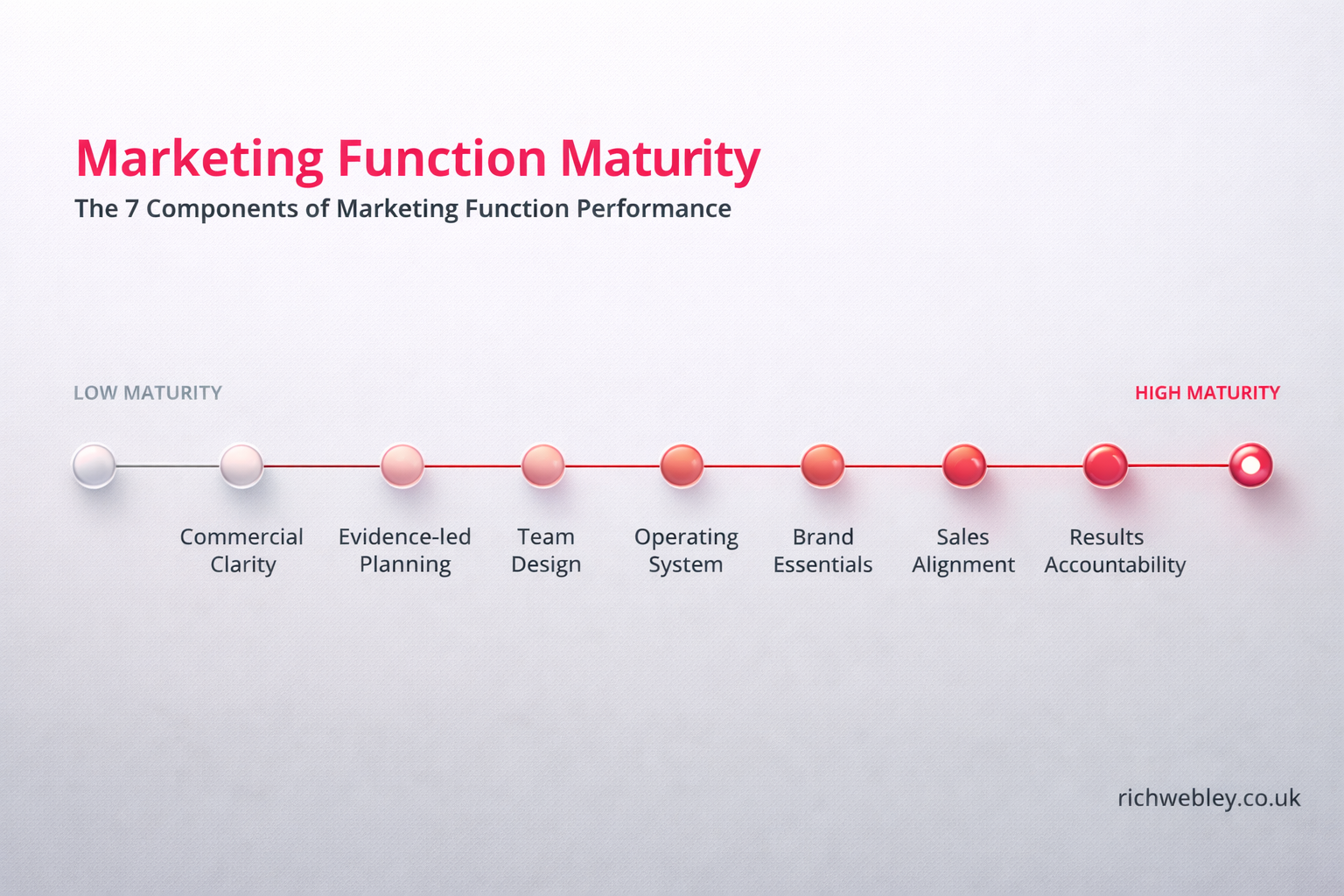
The components are:
- Commercial Clarity: A shared, explicit understanding of how marketing is expected to contribute to growth in this specific business.
- Evidence-Led Planning: Decisions grounded in evidence rather than assumption. Plans shaped by what is known to work, not guesswork or habit.
- Team Design: A structure and resourcing model with the right balance of experience, specialist skills, execution capacity, and room to grow.
- An Operating System: A repeatable rhythm for prioritisation, goal-setting, execution, and review - protecting focus and enabling sustained progress.
- Brand Essentials: A brand built to be noticed and remembered, using fit-for-purpose branding assets and messaging aligned with buyer needs.
- Alignment with Sales: Clear, two-way feedback loops between marketing and sales, with defined processes to surface and resolve issues that limit progress.
- Accountability for Results: Defined metrics, ownership and reporting. Measurement of outcomes, not just activity, with decision-making authority to match.
Each of these components plays a distinct role. None are optional. And none can substitute for another.
How the components interact
These seven components do not sit side by side in isolation. They reinforce each other and need to be built in the right order.
Commercial clarity shapes planning. Planning determines priorities. Priorities inform team design. The operating system creates momentum. Brand enables activity to compound. Sales alignment carries impact through to revenue. Accountability closes the loop and makes performance repeatable.
When the components start working together, marketing starts to feel very different.
Decisions become easier, trade-offs become clearer, and it starts to feel like you’re finally winning.
That said, performance only lifts when the whole system is in place (they rise or fall together). Improving one component in isolation rarely moves the needle.
Despite that reality, marketing functions rarely start from first principles.
They grow in response to immediate needs.
A sales push creates activity. A competitor move triggers a brand refresh. A skills gap leads to an agency appointment. A capacity issue prompts a hire.
Each decision adds something. Very few remove anything. Almost none address the system as a whole.
Over time, the function becomes an accumulation of parts rather than a deliberately designed setup. Which is why most businesses have some components - but not all.
Why weakness in one component caps performance
One of the most persistent myths in marketing is that excellence in one area can compensate for weakness in another.
A strong brand will overcome weak planning.
A great agency will make up for internal confusion.
A brilliant individual will fix a flawed structure.
In reality, marketing performance is constrained by its weakest component.
You can have compelling creative, but without commercial clarity it lacks focus. You can have strong planning, but without an operating system it never translates into momentum. You can invest in tools and talent, but without accountability results remain unpredictable.
This is why marketing frustration often feels disproportionate. Leaders see effort, cost, and activity, yet confidence never quite follows.
The visible work is real. The invisible gaps are what undermine it.
Activity increases, but impact fragments. Energy dissipates across too many initiatives, and progress feels slow despite constant effort.
Most leaders are frustrated that their marketing never really has the impact it should do, but they can’t put their finger on why. In most cases, they are one or two components short of having a function that works. They don’t have a marketing problem, they have a component problem.
Building maturity, not chasing fixes
The purpose of this model is not to give you another checklist. It is to provide a clearer way of seeing marketing effectiveness.
To understand why isolated fixes rarely work. To explain why effort doesn’t reliably translate into results. And to show why marketing maturity is ultimately a leadership decision, not a marketing one.
Not every business needs a fully mature marketing function. But any business expecting to outperform its market without one is relying more on hope than design.
If you find these articles and way of thinking useful, you can read more about my background and the type of work I do here or sign up to receive updates below.
Ready to Fix Your Marketing Function?
If you’re leading a £2–20m B2B business and recognise some of the patterns above, book a 25-minute Strategy Call.
We’ll assess your growth ambition, current marketing structure and determine the most appropriate next step.
Free of charge. No obligation.

